
AI for CIOs / Practical guidance
The CIO Brief
Make AI useful enough to adopt and clear enough to operate. Source ownership, tested access, integration decisions and support cost.

3 min read
Are you reducing IT tickets or just hiding unresolved questions?
Measure completed employee tasks, escalation quality and repeat contacts before claiming service-desk deflection.
Read the articleFind an answer you can use
Your questions. Practical answers.
51 articles to explore.
50 articles

Practical guides
Testing AI Assistants for Access-Boundary Failures: A CIO Guide
An accurate answer is not necessarily a safe answer. CIOs need evidence that an AI assistant can distinguish authorized knowledge access from a plausible-looking request—and refuse without revealing what it should protect.
Get the practical answer
Practical guides
Can Your AI Risk Review Prove Where Human Authority Begins?
An AI risk review is incomplete if it only lists system risks. CIOs also need to prove which decisions remain human, why the system must stop, and whether permissions, escalation, and audit records enforce that boundary.
Get the practical answer
Practical guides
When an AI Pilot Becomes a Production System, What Must the CIO Personally Own?
Moving an AI assistant into production is not only a technical release decision. The CIO must personally approve the use-case boundary, acceptable failure modes, and accountability model—while delegated owners provide evidence about sources, access, testing, and operations.
Get the practical answer
Practical guides
A CIO’s Practical AI Risk Evidence Register Before Scaling
Before expanding an AI use case, a CIO can use an evidence register to make source, access, workflow, oversight, and known-gap decisions reviewable at the proposed scope.
Get the practical answer
Practical guides
When Should a CIO Reopen an AI Risk Assessment?
An AI approval should not become permanent just because the system has not changed names. A new source, user group, integration, model, or failed denial test can change the risk boundary and should trigger review.
Get the practical answer
Practical guides
How CIOs Should Reassess AI Knowledge Access After a Vendor Goes Public
A vendor’s public-company transition is a reason to revisit an AI knowledge-access decision, not proof that broader deployment is justified. CIOs can assess the proposed expansion, test access boundaries, assign an accountable owner, and approve only the scope they can support.
Get the practical answer
Practical guides
When AI Risk Evidence Crosses Teams, Who Owns the Decision?
When evidence about an AI assistant is distributed across several control owners, no single team should be expected to infer authorization from partial facts. The accountable business owner should own the use-case decision, while control owners retain authority over risks in their domains and can trigger escalation or an immediate pause.
Get the practical answer
Practical guides
How CIOs Can Prove an AI Assistant Fails Safely When Sources Are Incomplete
An AI assistant is not ready to expand merely because it answers well-known questions. CIOs need evidence that it can recognize an evidence gap, respect source boundaries, and escalate uncertainty.
Get the practical answer
Practical guides
How CIOs Can Turn AI Risk Evidence Into a Renewal Decision
An initial AI approval is not a permanent entitlement. CIOs can use a renewal gate to assess whether a use case still operates within its approved purpose, access boundaries, source controls, and human oversight model.
Get the practical answer
Practical guides
A CIO Template for Evaluating AI Knowledge Access Before Approval
Before approving an AI system for controlled business knowledge, CIOs can test whether it answers from authorized sources, denies restricted requests, provides claim-level evidence, and can be rolled back when controls fail.
Get the practical answer
Practical guides
Who Owns the Evidence When an AI Assistant Answers Across Business Systems?
When an AI assistant combines HR, ticketing, and finance information, responsibility cannot be assigned to “the AI.” CIOs need clear ownership for source authority, access decisions, answer evidence, and denied-user testing.
Get the practical answer
Practical guides
A CIO Framework for Governing AI Agent Memory
AI agent memory can support continuity, but it also needs clear purpose, authority, scope, retention, and correction decisions. This CIO framework outlines the questions to ask.
Get the practical answer
Practical guides
How a CIO Can Prove an AI Assistant Respects Access Changes
A permission change is not proof that an AI assistant has stopped exposing sensitive information. CIOs need repeatable tests across retrieval, summaries, citations, and follow-up questions—then evidence of the result.
Get the practical answer
Practical guides
Who Signs Off When an AI Use Case Crosses a Business-Control Boundary?
An AI assistant does not become a business-control system merely because it is connected to more data. The control boundary changes when its output begins influencing supplier selection, records, workflows, or approvals. Here is a practical ownership and evidence framework for that moment.
Get the practical answer
Practical guides
How Should a CIO Compare AI Risk Evidence Across Business Units?
Two AI assistants may look similar on a roadmap while presenting very different governance questions. Here is a practical evidence-based method for comparing them.
Get the practical answer
Practical guides
When Should a CIO Retire an AI Use Case Instead of Adding Another Control?
More controls are not always the responsible answer. Here is how CIOs can decide whether to constrain, redesign, or retire an AI use case that repeatedly produces unverifiable answers, crosses source boundaries, or overwhelms human reviewers.
Get the practical answer
Practical guides
Can Your AI Assistant Identify the Document That Governs a Decision?
An AI assistant can retrieve the right-looking document and still give the wrong answer. CIOs can test whether it identifies the source that governs a decision, explains its reasoning, rejects weaker alternatives, and escalates unresolved conflicts.
Get the practical answer
Practical guides
What Should a CIO Record When an AI Access-Denial Test Fails?
An AI assistant’s refusal is not enough to prove governed access. CIOs need an evidence record showing who asked, what they requested, which sources were available, how the assistant responded, and whether the control was retested after remediation.
Get the practical answer
Practical guides
What Belongs in a CIO’s AI Risk Register Before Expanding a Knowledge Assistant?
A pilot can show that an AI assistant is useful. It does not, by itself, show that the system is ready for wider access. Here is the evidence a CIO should require before expansion.
Get the practical answer
Practical guides
Is a Scoped AI Integration Ready to Expand? A CIO Evidence Review
Before expanding an AI integration beyond a limited scope, CIOs can review whether its defined permissions, authorized use cases, observable evidence, and change controls support a wider deployment.
Get the practical answer
Practical guides
How to Design Stop and Restart Decisions for AI Workflows
Consequential AI workflows need defined pause conditions, named decision rights, an evidence record, and a controlled path to resume when access or evidence changes.
Get the practical answer
Practical guides
A CIO Framework for AI Workflows Using Uncertain Evidence
AI can help teams organize uncertain evidence without turning it into approved guidance. This framework helps CIOs distinguish discovery from decision support, assign evidence ownership, capture provenance, limit access and actions, and design for appropriate deferral.
Get the practical answer
Practical guides
Review AI Controls When Business Context Changes
Before an AI assistant moves into a new department or workflow, review whether its purpose, access boundaries, approvals, and escalation paths still fit the new context.
Get the practical answer
Practical guides
How Should a CIO Test Whether an AI Assistant Can Refuse the Wrong Request?
An AI assistant should not be judged only by how well it answers. Before launch, CIOs should test whether it can stay within approved knowledge boundaries, resist indirect requests, explain unavailable information, and produce reviewable evidence.
Get the practical answer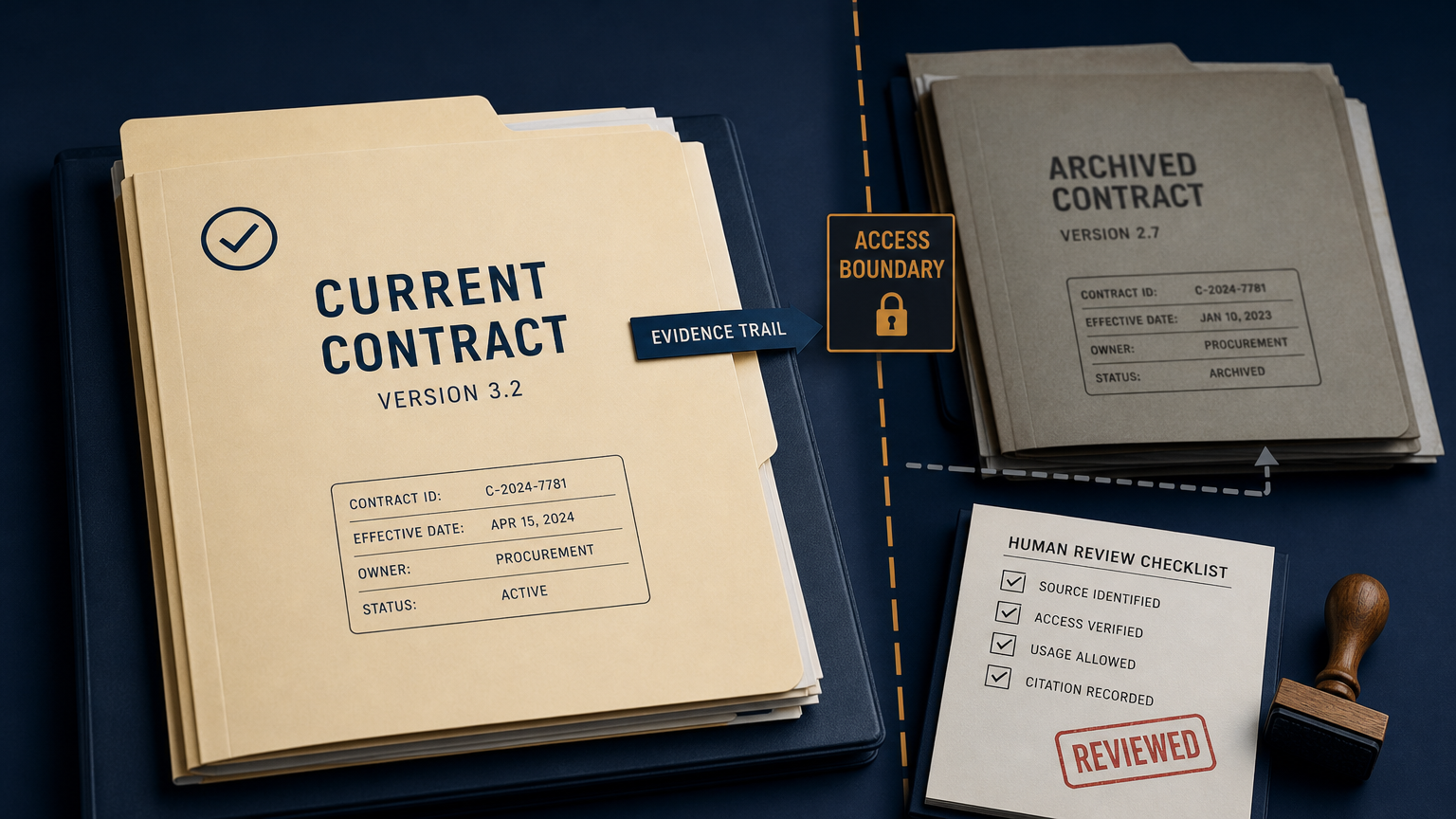
Practical guides
Can Your AI Assistant Prove It Was Allowed to Use That Source?
A useful AI answer needs more than a citation. CIOs should be able to show which source was used, why access was permitted, and what happened when evidence was missing or access was denied.
Get the practical answer
Knowledge governance
Test the access boundary before adding another source to your AI assistant
An executable acceptance test for permitted answers, denied questions, stale guidance and unsupported writes.
Get the practical answer
Connected systems
A connector logo is not an integration plan
Write the read, write, failure and maintenance contract before connecting an AI workflow to a business system.
Get the practical answer
AI investment
How do you prove an enterprise AI pilot is worth funding?
Calculate cost per accepted answer, include review and maintenance, and separate recovered capacity from cash savings.
Get the practical answerKnowledge governance
What belongs in a company AI source register?
Use a worked source record to distinguish permission, applicability, ownership and freshness before connecting documents.
Get the practical answer
AI architecture
RAG or fine-tuning: which problem are you actually trying to solve?
Choose between changing knowledge, consistent behavior and ordinary search using a task-based decision table.
Get the practical answer
Vendor evaluation
What should a CIO ask an AI vendor to show, not just promise?
Turn a polished demonstration into an evidence-led review of identity, data flow, failures, cost and exit options.
Get the practical answer
Production operations
When is an AI knowledge pilot ready for production?
Use explicit release gates for sources, permissions, answer quality, operations and rollback instead of a successful demo.
Get the practical answer
Answer quality
A citation is not proof: how do you check an AI answer?
Review support at the claim level and distinguish a real document from a current, applicable source that proves the answer.
Get the practical answer
IT leadership
How do you respond to shadow AI without driving it further underground?
Map the task people are trying to finish, offer an approved route and measure unresolved demand instead of issuing another blanket memo.
Get the practical answer
Knowledge governance
Your policy changed. How do you know the AI answer changed too?
Trace an approved update through ingestion, retrieval, caches and saved outputs using a controlled change test.
Get the practical answer
Connected systems
Before an AI agent can write: define exactly what it may change
Distinguish a proposed action from authorization and destination-confirmed completion before granting write access.
Get the practical answer
Production operations
An AI assistant gave the wrong instruction. What do you do first?
Contain the affected workflow, preserve useful evidence and identify whether the failure came from sources, access, generation or action.
Get the practical answer
IT leadership
What should a CIO put in an AI board update?
Show accepted business work, total cost, control evidence and the next investment decision instead of a tool inventory.
Get the practical answer
Vendor evaluation
Can you leave your AI vendor without losing your company knowledge?
Test export, ownership and continuity before procurement so the exit plan is more than a contract paragraph.
Get the practical answer
AI investment
How do you keep AI usage costs from becoming a surprise?
Budget by accepted task, expose retries and retrieval overhead, and give each workflow a cost owner and stop rule.
Get the practical answer
Knowledge governance
An employee changed teams. Did the AI permissions change too?
Test permission changes through identity, retrieval, caches and generated output instead of assuming a directory update reaches every layer.
Get the practical answer
AI architecture
One AI program across a portfolio does not mean one shared knowledge pool
Reuse evaluation and operating methods while testing company boundaries, local rules and support ownership separately.
Get the practical answer
Production operations
Your AI logs may be a second data store. Who owns them?
Inventory prompts, retrieved passages, responses, tool payloads and diagnostics before deciding what to retain.
Get the practical answer
Answer quality
How do you build an AI test set that tells you something useful?
Use representative employee tasks, deliberate failures and held-out cases instead of testing only the questions used to build the demo.
Get the practical answer
Production operations
The model changed. What needs retesting before employees use it?
Version the whole workflow and rerun task, access and action tests instead of assuming a model upgrade is a harmless swap.
Get the practical answer
Answer quality
Is it a hallucination, or did you give the AI the wrong source?
Locate the first failing stage before changing the model: authority, ingestion, retrieval, applicability, generation or review.
Get the practical answer
IT leadership
Why are employees ignoring your approved AI assistant?
Test whether people can find it, understand its scope, finish a real task and reach help before blaming resistance to change.
Get the practical answer
Knowledge governance
How should you prepare company documents for an AI knowledge pilot?
Resolve authority, applicability and missing context before worrying about file format or uploading more material.
Get the practical answer
AI investment
Build, buy or connect: how do you choose an enterprise AI approach?
Compare a bounded task, operating responsibility and exit cost rather than treating custom software and SaaS as opposing ideologies.
Get the practical answer
Vendor evaluation
What should an enterprise AI RFP require vendors to prove?
Ask for deployment-specific evidence and acceptance cases so a procurement response cannot substitute a capability claim for a tested requirement.
Get the practical answer