AI for CIOs
Can Your AI Assistant Prove It Was Allowed to Use That Source?
SimplSolutions Editorial Team · 8 min read
Published
The real question is not “Did the assistant cite a source?”
Before an employee acts on an AI-generated answer, a CIO should be able to answer three separate questions:
- What source material supported the answer?
- Why was the assistant allowed to use that material for this user and task?
- What did the system do when the source was unavailable, restricted, incomplete, or potentially stale?
A citation can help with the first question. It does not, by itself, establish that the source was current, authorized, relevant, or complete.
This distinction matters most when an answer can trigger a business decision: renewing a supplier, approving a payment, changing a customer record, interpreting a policy, or responding to a regulatory request. In those cases, “the model found a document” is not an adequate control description.
What NIST guidance contributes—and what it does not
The NIST AI Risk Management Framework is intended to help organizations manage risks associated with artificial intelligence and incorporate trustworthiness considerations into the design, development, use, and evaluation of AI systems.
NIST states that the AI RMF is intended for voluntary use. It is a framework for organizing risk management, not a claim that an organization is compliant merely because it references NIST. It also does not automatically establish that a particular assistant has permission to access a particular source.
For CIOs, the useful move is to translate broad risk-management language into an evidence-and-access review. The review should connect:
- Business purpose: What decision is the assistant supporting?
- Source authority: Which records are approved for that decision?
- Access scope: Which users, roles, or tasks may use those records?
- Evidence traceability: Can a reviewer reconstruct the material that informed the answer?
- Failure behavior: Does the assistant stop, qualify, or escalate when evidence is missing?
- Accountability: Who owns the unresolved decision?
That is a practical interpretation of responsible operation—not a statement that NIST mandates a particular implementation.
A worked example: a supplier-renewal question
Imagine that a procurement employee asks an AI assistant:
“Should we renew the contract with Northstar Components, and what changed since the last term?”
A weak answer may produce a confident recommendation based on a document with a familiar supplier name. It might even include a link. But several questions remain open:
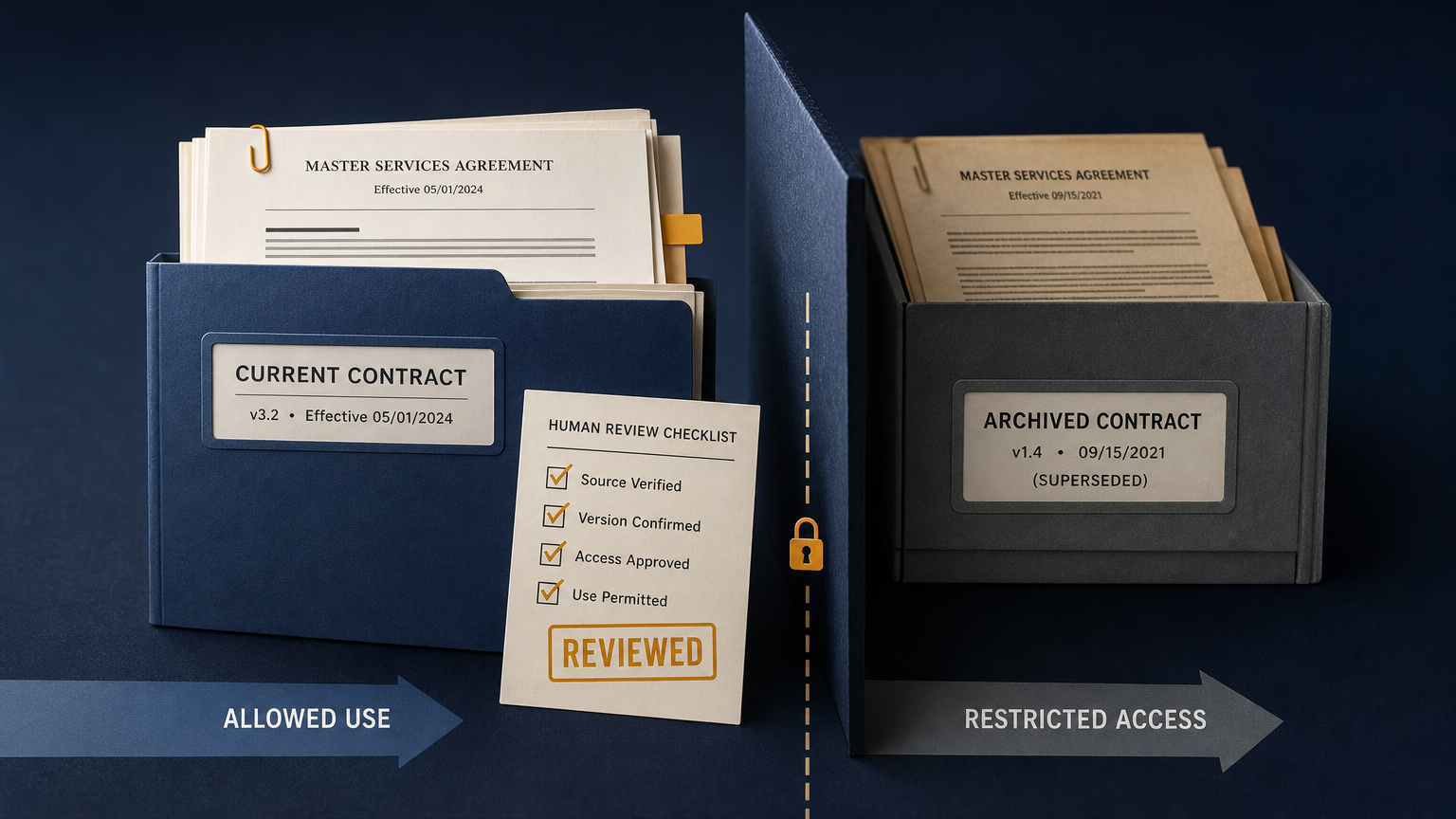
- Was the document the currently approved contract?
- Was it an executed agreement, a negotiation draft, or an archived version?
- Was the employee authorized to use the commercial terms?
- Did the assistant also retrieve unrelated files from the employee’s workspace?
- Were amendments, renewal notices, or termination rights missing from the evidence?
- Did the assistant distinguish contract facts from a recommendation?
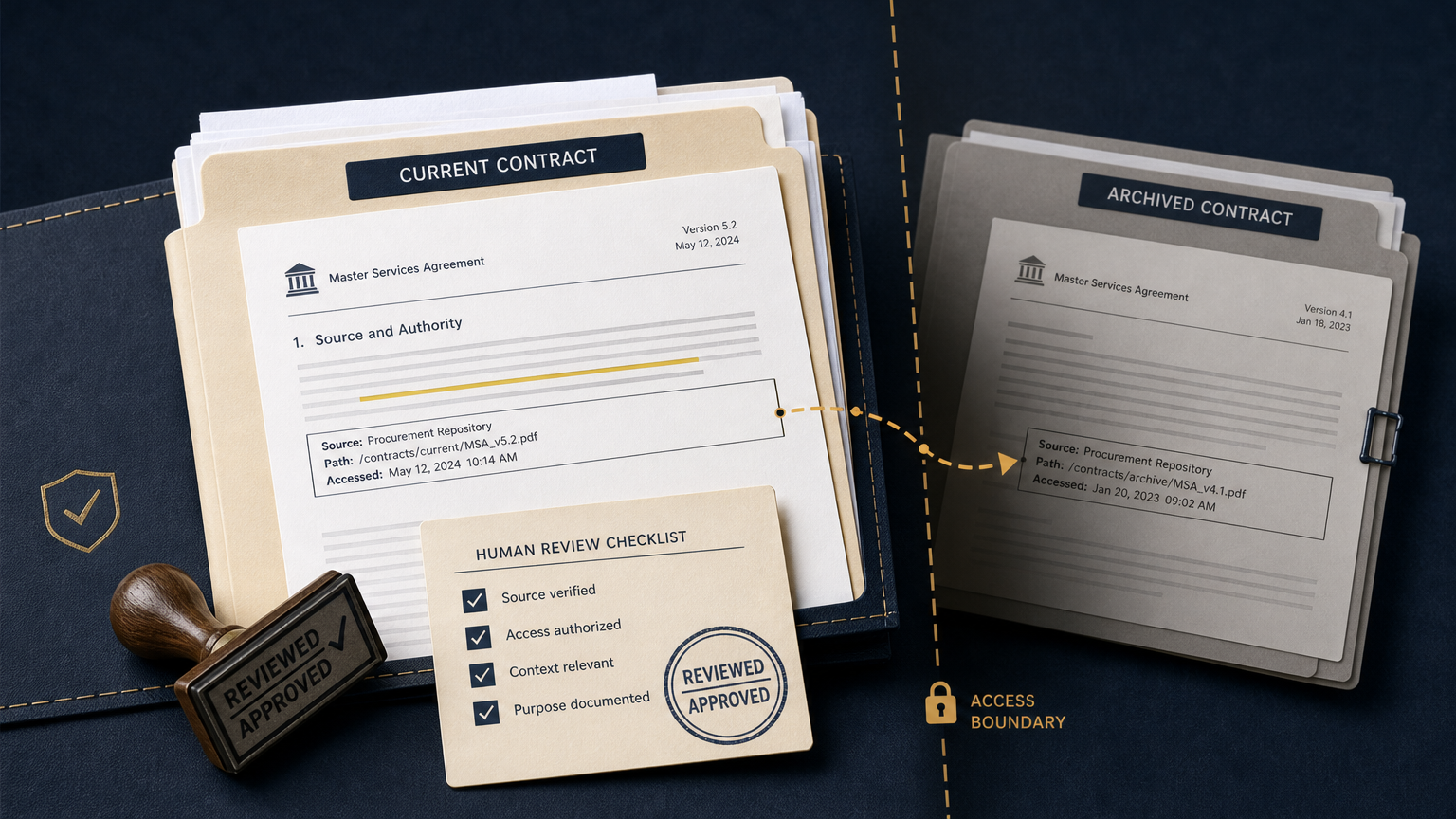
A defensible answer would make the source boundary visible. It would identify the approved contract or contract set used, indicate the relevant version or effective period, and make the access basis reviewable without exposing material the user was not entitled to see.
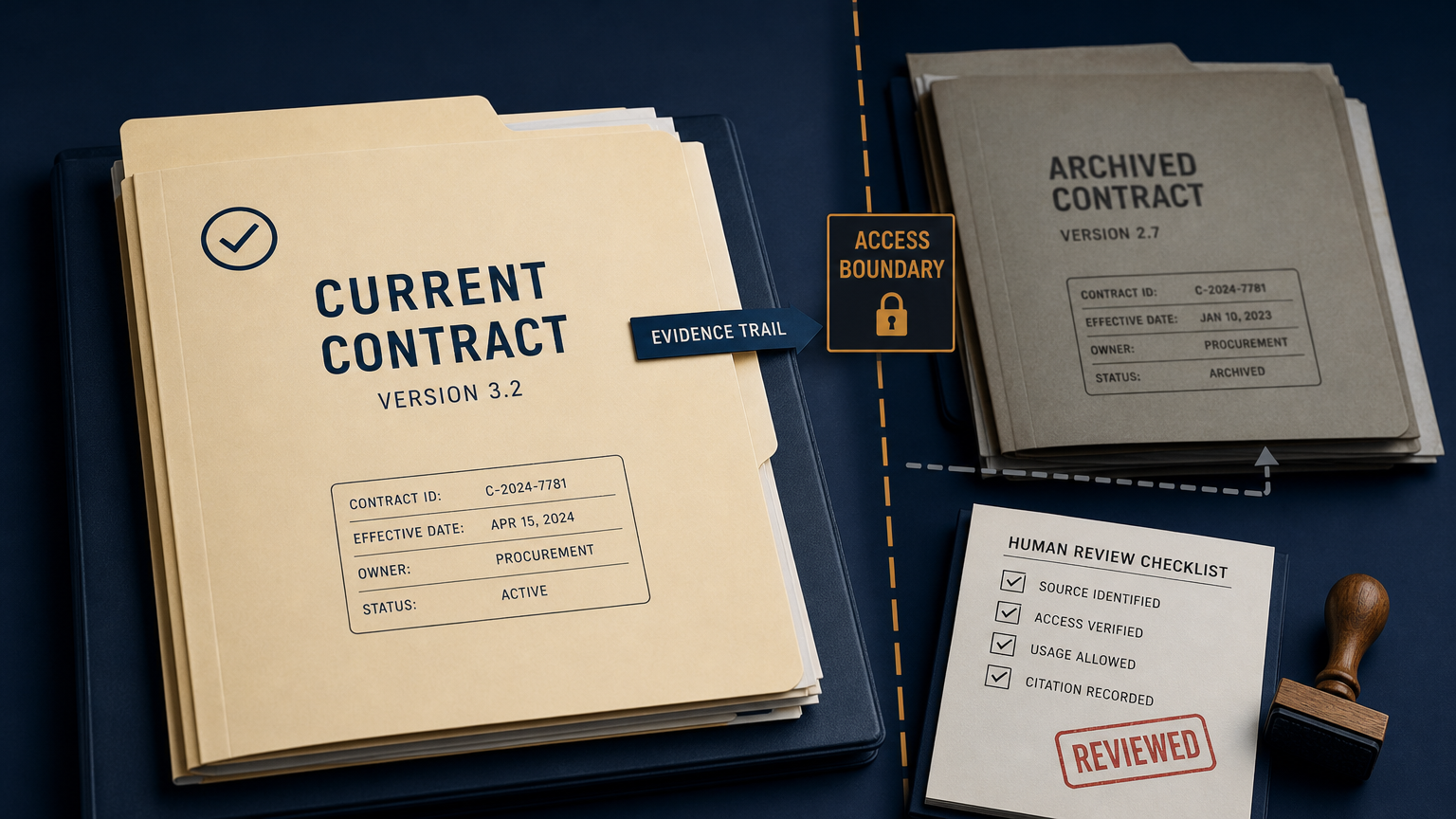
If the current approved contract could not be accessed, the assistant should not silently substitute an older file or infer that the latest-looking document is authoritative. The answer should state that the evidence is insufficient for a renewal recommendation and route the question to an appropriate human owner, such as procurement, legal, or the contract manager.
The important control is not a particular interface feature. It is the organization’s ability to distinguish supported, authorized, and decision-ready evidence.
Four tests for a governed AI answer
1. Source identity: can the organization name what was used?
A reviewer should be able to identify the source records that materially informed the answer. Depending on the use case, that may include a document title, business record, effective date, version, owner, or other stable reference.
The level of detail should match the sensitivity of the decision. A low-risk internal summary may need only a clear source reference. A recommendation affecting contractual, financial, employment, health, or customer outcomes may require a more complete evidence record.
The goal is not to preserve every internal processing detail. The goal is to give a responsible reviewer enough information to determine whether the answer rests on the right evidence.
2. Permission basis: was access appropriate for this task?
Access should be evaluated in context. A user may be allowed to view a document for one business purpose without granting an assistant unrestricted permission to combine it with every other source available to that user.
A useful review asks whether the assistant’s source access was scoped by relevant factors such as:
- the user or service identity;
- the business role and task;
- the source’s sensitivity and ownership;
- the decision domain;
- the permitted integration boundary; and
- the time at which access was evaluated.
This is why “the employee could open it” is not always a sufficient explanation. An assistant may combine information at a scale or in a context that the original document-sharing practice did not anticipate. CIO ownership requires defining which source relationships are acceptable before the answer is relied upon.
3. Denied-access behavior: what happens when the answer cannot be completed?
A mature review includes cases where the assistant should not receive the requested information. For example, a procurement assistant may be able to view approved contract metadata but not privileged legal advice or a confidential negotiation draft.
The review should examine whether the assistant:
- acknowledges the missing or denied evidence;
- avoids reconstructing restricted content from indirect clues;
- avoids treating a nearby but unauthorized file as an acceptable substitute;
- preserves the boundary between what is known and what is inferred; and
- identifies a human owner for the next decision.
An access denial is not merely a technical exception. It is a business signal. It may mean the question is out of scope, the source classification is wrong, the integration needs review, or the decision requires a person with the right authority.
4. Evidence quality: is the answer complete and current enough?
Authorization does not make evidence reliable. A user may be permitted to access an outdated policy, an unsigned contract draft, or a partial case record.
The assistant and its operating process should therefore distinguish at least three conditions:
- Authorized and supported: the relevant source is approved, accessible, and adequate for the question.
- Authorized but incomplete or stale: the source may be permitted, but it cannot support a confident conclusion without qualification or additional review.
- Unavailable or unauthorized: the assistant must not fill the gap with guesswork or an alternative source outside the approved boundary.
This classification gives business owners a more useful control than a simple “answer generated” event.
Why source governance belongs to the CIO
Source governance is often treated as a records, security, legal, or knowledge-management issue. It is all of those—and it is also an operating model issue for AI.
When an assistant can search across business systems, the organization is deciding which records may influence decisions and under what conditions. That decision affects confidentiality, accuracy, accountability, and the ability to investigate an incident later.
CIO ownership does not mean centralizing every decision in IT. It means establishing the conditions under which a business team can responsibly use an assistant, including:
- a named owner for each important source domain;
- clear definitions of authoritative and non-authoritative records;
- scoped integrations rather than broad, unexplained access;
- reviewable evidence for consequential outputs;
- tests for denied and incomplete access; and
- escalation paths when the assistant cannot establish a reliable basis.
Teams can then adapt those controls to procurement, finance, HR, customer operations, healthcare administration, or other domains without assuming that one access rule fits every use case.
What a responsible operator should review next
Start with one high-value question rather than a general claim that an assistant is “grounded.” For example: supplier renewal, invoice exception handling, or a policy interpretation that affects employee action.
Ask the business owner and system owner to demonstrate:
- Which sources are approved for the question.
- How source authority and freshness are determined.
- What evidence a reviewer receives with the answer.
- How access is scoped to the user, task, and source.
- What happens when the authoritative source is denied or unavailable.
- How stale, conflicting, or incomplete records are disclosed.
- Who accepts responsibility when the assistant cannot support a recommendation.
Record the gaps as operating decisions, not just model-quality defects. A missing contract amendment may require a records correction. A broad integration may require an access review. An unresolved recommendation may require a human approval step.
The useful next step is not to ask whether an assistant sounds confident. It is to select one consequential workflow and test whether the organization can prove the answer was both supported by the right source and allowed to use it.
The takeaway
A trustworthy AI answer needs two kinds of traceability:
- Evidence traceability: what information supported the answer?
- Access traceability: why was the assistant permitted to use that information?
CIOs should also require a visible failure path. When the current approved source is missing, restricted, stale, or incomplete, the assistant should not quietly improvise. It should disclose the limitation and place the decision with an accountable human owner.
That standard turns AI risk management from a broad aspiration into a reviewable business control—without pretending that voluntary guidance, citations, or access permissions alone solve the problem.